Private equity firms face an uncomfortable truth in 2025: their mid-market portfolio companies are bleeding margin through operational inefficiencies that traditional cost-cutting can’t fix. While 53% of these companies now spend over 5% of revenue on technology, they’re simultaneously losing 20-30% of annual revenue to preventable operational waste. The math is brutal, and the competitive pressure is intensifying.
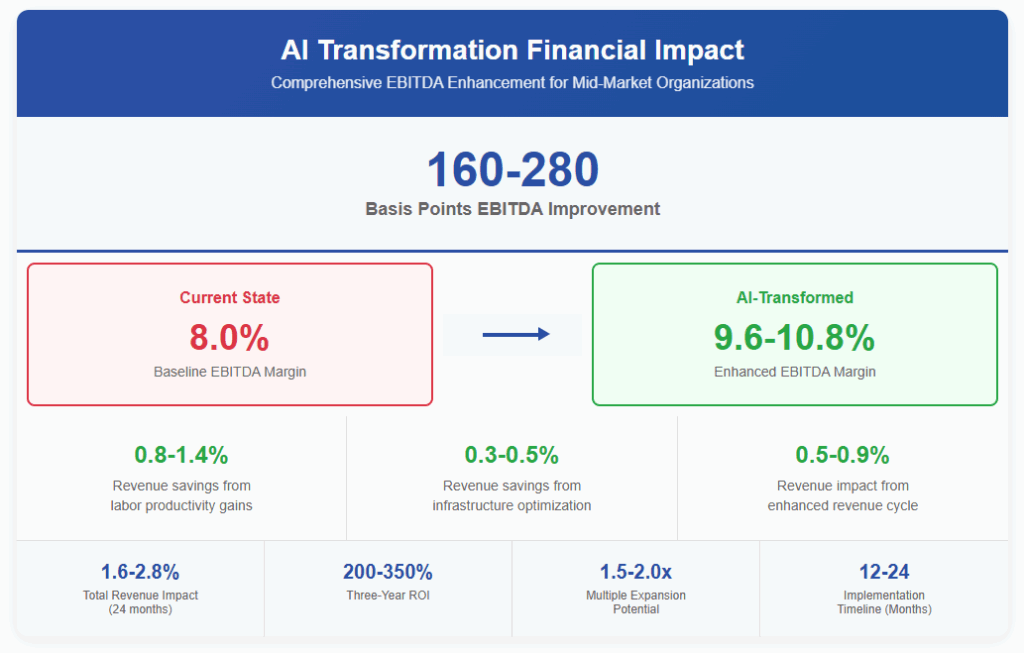
But there’s a counterintuitive insight emerging from early adopters: the solution isn’t spending less on technology—it’s spending smarter through AI-enabled IT transformation. Organizations implementing comprehensive AI strategies are achieving 160-280 basis points of EBITDA improvement within 24 months, elevating margins from typical 8% baselines to 9.6-10.8%. More critically, PE firms coordinating these transformations across their portfolios are realizing 40% cost savings versus independent implementations while compressing deployment timelines by half.
This isn’t incremental improvement—it’s structural transformation that compounds over time. The question facing PE firms isn’t whether to pursue AI-enabled operations, but how quickly they can capture value before the competitive window closes.
Why Mid-Market IT Spending Has Reached a Breaking Point
Mid-market companies have hit a breaking point with IT spending. In 2024 and early 2025, IT expenditures surpassed even COVID-era peaks, yet 60-80% of this spending services legacy system maintenance rather than innovation. This creates profound structural drag on portfolio performance.
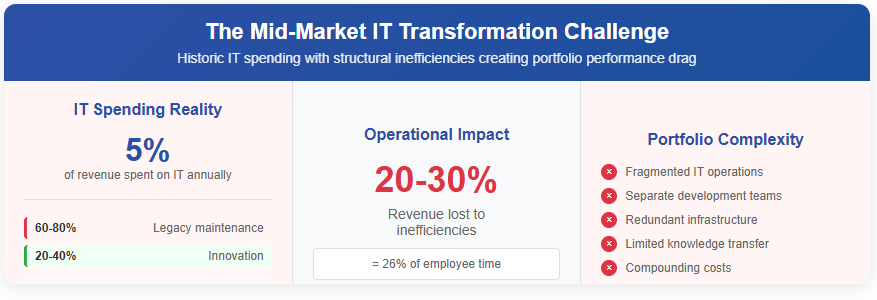
The metrics are clear:
- Mid-market enterprises allocate 4-6% of revenue to IT (versus 3.7% for large organizations)
- Approximately 2-3% of revenue supports legacy operations alone
- Companies lose 20-30% of annual revenue to operational inefficiencies
- This translates to 26% of employee time consumed by non-value-add activities
For a typical mid-market company spending 5% of revenue on IT, this represents significant capital locked in maintenance mode rather than growth initiatives.
Private equity portfolios compound this challenge through fragmented IT operations. Each portfolio company maintains separate development teams, infrastructure management, and data operations—creating redundancies that multiply costs while limiting knowledge transfer and best practice implementation across holdings.
How AI Actually Changes IT Economics
Artificial intelligence fundamentally alters the economics of IT service delivery through three primary mechanisms: development acceleration, intelligent automation, and predictive analytics.
Core IT transformation metrics:
| IT Area | Key Metric | Business Impact |
|---|---|---|
| Development Acceleration | 40–60% faster coding through AI assistance | Reduced time-to-market for new features and applications |
| Infrastructure Optimization | 50% reduction in infrastructure costs | Intelligent resource allocation, scripting, and automated scaling |
| Asset Management | 97% accuracy in asset tracking | Automated discovery and lifecycle management |
| System Availability | 99.98% uptime through predictive monitoring | Minimized disruptions to patient care delivery |
| Incident Response | 74% faster alert response time | AI-powered diagnostics and automated remediation |
Operational process improvements:
| Operational Area | Key Metric | Business Impact |
|---|---|---|
| Non-Value Add (NVA) Processes | 52% reduction in NVA time | Less administrative overhead, increased process automation, and improved compliance |
| Revenue Operations | 3–5% net revenue improvement | AI-augmented process automation, exception reporting, and follow-up management |
| Missed Sales Opportunities | 40% reduction in missed meetings/opportunities | Predictive analytics with targeted interventions |
Development Acceleration
AI-assisted development reduces coding time by 40-60% while improving code quality and documentation. Modern AI tools enable automated code generation from natural language specifications, intelligent refactoring of legacy codebases, real-time error detection and correction, and comprehensive documentation generation. This isn’t about replacing developers—it’s about amplifying their productivity and eliminating tedious maintenance work. (in hours example)
Intelligent Automation
Repetitive tasks across infrastructure management, data operations, and support functions are systematically eliminated through automated data pipeline creation and optimization, intelligent ticket routing and resolution, predictive maintenance scheduling, and self-healing infrastructure that resolves issues autonomously. The goal is removing human intervention from routine operations while maintaining appropriate oversight for critical decisions.
Predictive Analytics
Proactive issue resolution reduces downtime and improves service reliability. Capacity planning optimization reduces overprovisioning by 30-50%, performance degradation prediction enables preventive action, user behavior analysis improves service design, and anomaly detection prevents 70% of potential outages. This shifts IT from reactive firefighting to strategic capacity management.
The Financial Trajectory
AI-enabled IT transformation follows a predictable financial pattern for mid-market organizations. Initial implementation costs are quickly offset by operational efficiencies, with break-even typically occurring by month 6 and cumulative savings reaching 6.2% of revenue by year 3. This reflects the compounding nature of AI benefits as automation capabilities expand across business operations.
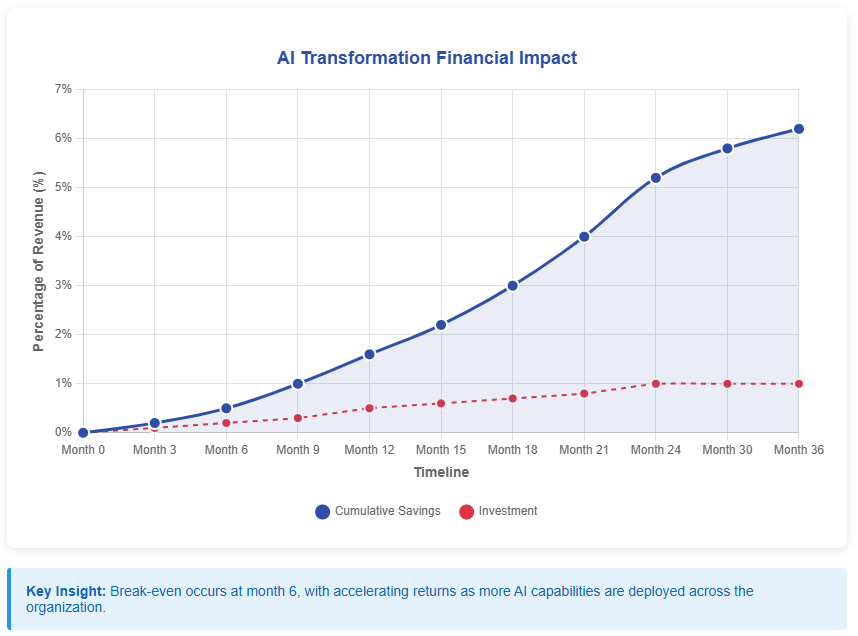
The curve accelerates because each automation enables subsequent automations—creating a flywheel effect that traditional cost reduction approaches can’t match.
What Actually Happened: Real Portfolio Company Results
The transformation of mid-market companies within PE portfolios demonstrates tangible impact beyond theoretical projections. These organizations faced challenges common to growing companies: need for specialized IT skillsets, fragmented data systems, manual processes, and escalating IT costs requiring comprehensive operational improvement.
Development and Infrastructure Results
The implementation delivered measurable outcomes across core areas:
- Development cycles: 50% faster through AI-assisted coding
- Cloud infrastructure: 60% reduction in provisioning time via AI-assisted scripting, troubleshooting and deployment
- Support operations: 20% faster issue resolution using AI-assisted diagnostics
- Fractional resources: Access to specialized talent pool as needed during scaling
- Cost structure: Achieved with significantly lower investment than traditional approaches
Unifying Fragmented Systems
Through backend integration of multiple administrative systems, unified experiences were delivered to both end customers and operations staff, with development work optimized through AI assistance and augmentation.
The challenge: Complex system integration from ERP, scheduling, and third-party systems requiring extensive developer resources and causing backoffice overhead.
The solution: AI-augmented development of real-time synchronization platform to keep offices, providers, and disparate systems fully coordinated.
Results: 30% reduction in development effort, eliminated need for multiple dedicated developers, state synchronization across domain-specific apps, and reduction in booking conflicts and backoffice overhead.
Cutting Web Development Time in Half
Through AI-assisted development, engineers delivered customer-facing solutions effectively and efficiently, reducing time-to-market and significantly reducing costs.
The challenge: Manual provider information management in multiple systems with limited search functionality.
The solution: AI-augmented development of intuitive portal with clean UI.
Results: Development time reduced by 50% through intelligent code generation, delivered in record time with significantly lower total cost, improved user satisfaction and operational efficiency.
Operational Analytics and Data Warehousing
Operational dashboards covering all KPIs were delivered, allowing for detailed drilldowns and end-to-end optimization of business health and performance.
The challenge: Enterprise-wide data integration from multiple sources requiring extensive developer resources to deliver real-time leadership operational dashboards and performance metrics.
The solution: AI-assisted development of ETL processes with automated data transformation, resulting in a business-critical dashboard system used daily to determine operational health across all aspects of the business.
Results: Improved data quality and processing speed, real-time analytics capability enabled consolidating core domain-specific KPIs, such as: appointments, patient distribution, compensation, resource utilization, operational benchmarking, and customer engagement.
Asset Management
Starting from a fragmented environment with significant compliance risks, comprehensive asset lifecycle management was implemented.
Initial state: 800+ assets across multiple locations, 500+ endpoints manually tracked, 100+ cloud resources with limited visibility, decentralized management creating compliance risks.
Results: 97% asset record accuracy achieved through automated discovery, 75% reduction in asset onboarding time, 100% compliance coverage, automated lifecycle management from procurement to retirement.
IT Support and Expert Fractional Resources
Growth-stage companies have extensive IT and development needs, but delivering these services in a fractional, on-demand, all-inclusive manner solves a critical scaling problem.
The challenge: Early stage companies need a breadth of IT and development services but cannot support FTE for these roles. Fluctuations and spikes in demand for varying high-skill services occur regularly. Managing multiple IT and engineering vendors is expensive and operationally challenging.
The solution: A one-stop shop for all IT and development services, offering global, fractional resources on demand.
Results: Companies able to scale, open new offices, and adjust to IT needs on-demand in a cost-effective manner. IT and technical support costs further reduced leveraging global onshore, nearshore, and offshore teams to bring the right resources at the right cost. AI-assisted backend practices deliver more efficient and effective resources, further reducing end costs.
The Bottom Line
These portfolio companies scaled efficiently by gaining access to highly-skilled talent pools at fractional rates, netting the benefits of all-inclusive IT without cost-prohibitive overhead. AI-augmented development, data, and IT processes continue to deliver systemic cost reductions and operational efficiencies, regardless of underlying platforms and domain-specific applications utilized.
Financial Impact Analysis for PE Portfolios: Breaking Down the EBITDA Math
The financial returns from AI-enabled IT transformation follow predictable patterns that enable accurate portfolio modeling.
For a typical mid-market organization spending 5% of revenue on IT, comprehensive transformation delivers quantifiable improvements across three primary value drivers.
1. Labor Productivity Impact
Mid-market companies typically spend 25-30% of revenue on total labor, with administrative and support functions representing 5-6% of total revenue (20% of labor costs). AI productivity gains of 15-25% translate to 0.8-1.4% of revenue in annual savings—not through headcount reduction, but through redeploying talent to revenue-generating activities.
2. Infrastructure Optimization
Typical infrastructure over provisioning ranges from 30-50%, with annual infrastructure spend for mid-market companies typically reaching 1% of revenue. AI-driven optimization delivers 0.3-0.5% of revenue in annual savings while maintaining 99.9%+ availability. This eliminates waste without compromising reliability—a balance traditional approaches struggle to achieve.
3. Revenue Cycle Enhancement
Process automation reduces billing errors by 15-20%, faster collections improve cash flow timing, improved working capital management reduces bad debt, and the net revenue impact reaches 0.5-0.9% of revenue annually. This represents top-line growth, not just cost reduction.
EBITDA Impact Summary
For an organization operating at 8% EBITDA margins, the combined impact delivers:
- Total improvement: 1.6-2.8% of revenue within 24 months
- EBITDA enhancement: 160-280 basis points
- Multiple expansion potential: 1.5-2.0x current sector averages
- Three-year ROI: 200-350%
These aren’t projections—they’re based on actual implementations across multiple portfolio companies with consistent results.
Implementation Framework: 3 Phased Approach for Portfolio-Wide Adoption
Most PE firms approach AI transformation the wrong way—they either move too cautiously, running endless pilots that never scale, or they attempt wholesale transformation that overwhelms organizations and burns through budgets. Neither approach works.
The firms seeing actual results follow a different pattern. They move deliberately but quickly, building momentum through visible wins while systematically expanding capabilities. This isn’t about being careful—it’s about being strategic. Each phase creates the foundation for the next, compounding results while minimizing disruption.
The three-phase approach isn’t arbitrary timing—it reflects how organizations actually absorb change and how AI capabilities build on each other. You can’t jump to advanced analytics without first establishing data quality. You can’t implement predictive infrastructure without baseline monitoring. The sequence matters as much as the individual components.
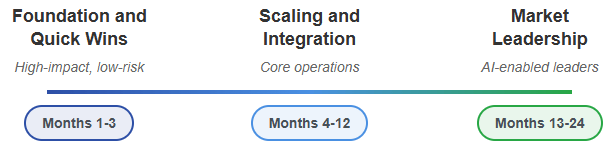
Implementation Framework at a Glance
| Phase | Timeline | Focus | Key Initiatives | Investment | Expected Results | Strategic Goal |
|---|---|---|---|---|---|---|
| Phase 1: Foundation and Quick Wins | Months 1-3 | High-impact, low-risk implementations that build organizational confidence | • AI-Assisted Development (GitHub Copilot, Claude Code, AWS CodeWhisperer) • Cloud Cost Optimization (AI-driven resource management) • Basic Automation (RPA for data entry, scheduling, logistics) | 0.05-0.1% of revenue | • 40-60% faster coding • 20-30% cloud cost reduction in 90 days • 70% efficiency gain on targeted processes | Prove AI works in your environment; build organizational buy-in |
| Phase 2: Scaling and Integration | Months 4-12 | Expanding AI into core business operations and revenue-generating processes | • Revenue Operations Transformation (AI-powered authorization, automated claims) • AI-Assisted Documentation (transcription integrated with business systems) • Predictive Infrastructure (AI monitoring, self-healing capabilities) | 0.2-0.4% of revenue | • 0.5-1.5% net revenue improvement • 2+ hours daily savings per professional • 70% downtime reduction | Embed AI in how business operates; shift from cost reduction to revenue enhancement |
| Phase 3: Market Leadership | Months 13-24 | Creating competitive advantage through capabilities competitors can’t easily replicate | • Advanced Analytics (predictive capacity planning, real-time process insights) • Proprietary AI Development (custom models using organizational data) | 0.4-1.0% of revenue | • Predictive business management • Unique capabilities from proprietary data • Self-sustaining AI culture | Build defensible competitive moat; transform from AI-user to AI-enabled business |
| Overall Program | 24 months | Complete transformation from pilot to market leadership | All components above, implemented sequentially with each phase building on previous | 0.4-1.0% of revenue (total) | • 160-280 basis points EBITDA improvement • 200-350% three-year ROI • 1.5-2.0x multiple expansion potential | Systematic value creation with compounding returns |
Phase 1: Foundation and Quick Wins (Months 1-3)
The first 90 days determine whether transformation gains organizational buy-in or dies in committee meetings. This phase focuses exclusively on implementations that deliver visible results quickly while requiring minimal process change. The goal isn’t comprehensive transformation—it’s proving the concept works in your specific environment.
Basically, focus on high-impact, low-risk implementations that build organizational confidence:
AI-Assisted Development
- Deploy GitHub Copilot, Claude Code, AWS CodeWhisperer, or similar across teams
- Expected productivity gain: 40-60%
- Investment: 0.01-0.03% of revenue
Cloud Cost Optimization
- Implement AI-driven resource management and optimization
- Expected savings: 20-30% within 90 days
- Investment: 0.02-0.04% of revenue
Basic Automation
- Deploy RPA for routine tasks
- Target processes: data entry, code validation, customer scheduling, logistics
- Expected efficiency gain: 70% for targeted processes
The critical insight from Phase 1: you’re not just implementing technology, you’re building organizational confidence. By the end of month 3, skeptics should be asking what comes next, not questioning whether AI works.
Phase 2: Scaling and Integration (Months 4-12)
Once quick wins establish credibility, Phase 2 expands AI adoption into core business operations. This is where transformation shifts from interesting experiment to fundamental operational change. The implementations here touch revenue-generating processes and customer-facing systems, requiring more careful change management but delivering substantially larger impact.
Revenue Operations Transformation
- Implement AI-powered prior authorization
- Deploy automated coding and claims optimization
- Expected improvement: 0.5-1.5% net revenue
- Investment: 0.1-0.2% of revenue
AI-Assisted Documentation
- Integrate documentation and transcription AI services with existing customer-facing business systems
- Expected time savings: 2+ hours per professional daily
- Investment: 0.06-0.1% of revenue
Predictive Infrastructure
- Transition to AI-driven monitoring and maintenance
- Implement self-healing capabilities
- Expected downtime reduction: 70%
- Investment: 0.04-0.08% of revenue
Phase 2 typically takes 8-9 months because it requires deeper integration with existing systems and more extensive change management. Resist the urge to rush—the goal is sustainable transformation, not quick implementation followed by gradual abandonment. By month 12, AI should be embedded in how the business actually operates, not bolted on as experimental tools.
Phase 3: Market Leadership (Months 13-24)
The final phase separates companies that implemented AI from companies that became AI-enabled businesses. This is where transformation creates genuine competitive advantage through capabilities competitors can’t easily replicate. The investments here are larger and the payback periods longer, but the strategic value compounds indefinitely.
Advanced Analytics
- Predictive capacity and logistics planning
- Real-time process insights and management
- Investment: 0.1-0.2% of revenue
Proprietary AI Development
- Custom models leveraging organizational data
- Unique competitive advantages
- Investment: 0.2-0.4% of revenue
By month 24, the organization should be fundamentally different—not just more efficient, but operating with capabilities that didn’t exist two years earlier. The transformation isn’t complete (it never is), but it’s self-sustaining. Teams are identifying new AI applications without external prompting. The culture has shifted from “how do we do this?” to “how could AI improve this?”
Total Investment and Return Potential
| Implementation Level | Investment Range | Payback Period | Three-Year ROI |
|---|---|---|---|
| Pilot Implementation | 0.05–0.1% of revenue | 6-month payback | 200–350% |
| Comprehensive Deployment | 0.2–0.4% of revenue | 12-month payback | – |
| Full Transformation | 0.4–1.0% of revenue | 18-month payback | – |
Why Coordinated Transformation Across Portfolios Works Better
Private equity portfolios unlock unique value through coordinated AI transformation that individual companies cannot replicate. The math is compelling.
Cost Synergies
For a portfolio of five companies:
- Independent implementation: 1-2% of portfolio revenue total investment
- Coordinated implementation: 0.6-1.2% of portfolio revenue total investment
- Savings: 40% reduction in total investment
- Improved outcomes: Best practices shared across portfolio
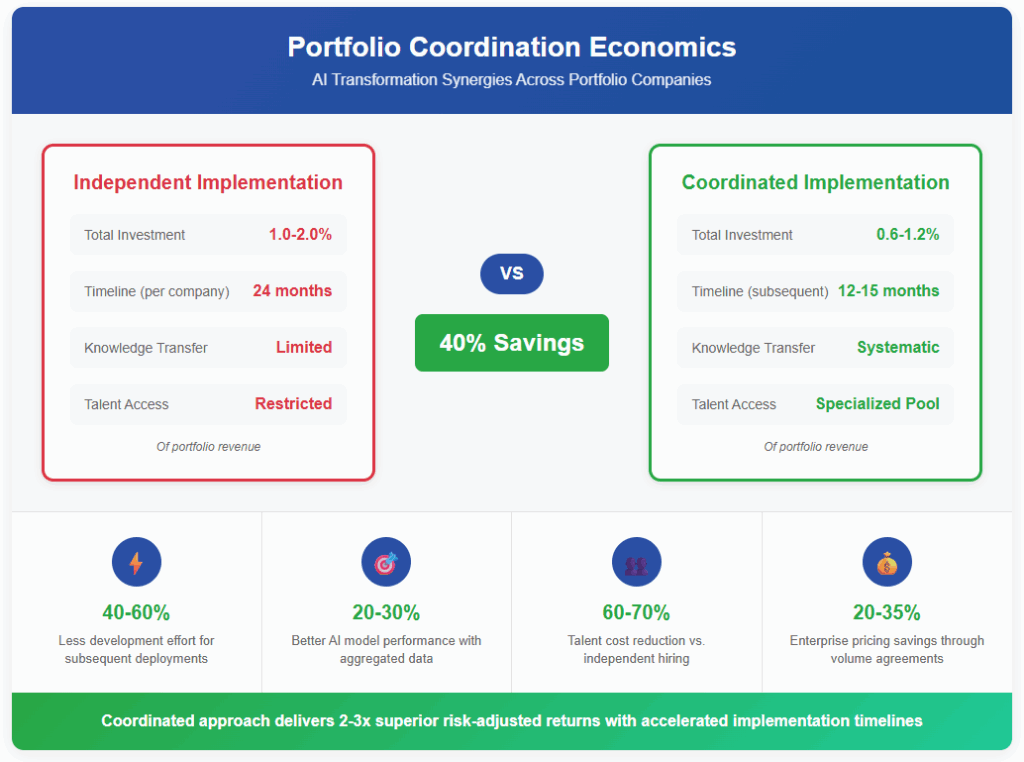
The coordinated approach doesn’t just cost less—it delivers better results through shared learning and standardized approaches.
Knowledge Transfer Benefits
Solutions developed for one company adapt to others with 40-60% less effort. AI models trained on aggregated (anonymized) data perform 20-30% better than models trained on single-company datasets. Implementation timelines compress from 24 months to 12-15 months for subsequent deployments as the team gains experience and refines methodologies.
This creates a compounding advantage where each implementation makes the next easier and more effective.
Talent Leverage
Centralized AI expertise supporting multiple portfolio companies enables access to specialized skills (data scientists, AI engineers) no single company could justify hiring. Cost per company reduces by 60-70% versus independent hiring, continuous improvement occurs as the team gains cross-portfolio experience, and knowledge retention remains within the portfolio even with individual company exits.
This solves the talent shortage problem that plagues individual companies trying to build AI capabilities independently.
Vendor Negotiations
Portfolio-wide agreements generate significant advantages: enterprise pricing delivers 20-35% cost savings, standardized technology stacks simplify integration, and volume commitments unlock advanced features and priority development from vendors. The collective buying power of a PE portfolio transforms vendor relationships from transactional to strategic.
Compliance and Security: What You Need to Know
Enterprise AI implementation requires rigorous attention to regulatory compliance and risk management. This isn’t optional—it’s foundational to sustainable transformation.
Regulatory Compliance & Privacy Framework
Data Privacy Requirements:
- All AI systems must maintain comprehensive audit trails for data processing activities
- Customer and employee data used for AI training requires explicit consent and transparent disclosure
- Implement data minimization principles—collect and process only necessary data
- Establish clear data retention and deletion policies aligned with regulatory requirements
State Privacy Laws:
- Comply with state-specific rules (CCPA, CCPA 2.0/CPRA, BIPA, CTDPA, CPA, etc.)
- Implement comprehensive consent management across all jurisdictions
- Maintain state-specific data residency controls and cross-border transfer protocols
- Establish consumer rights processes (access, deletion, correction, opt-out)
Federal Compliance Considerations:
- SOX Compliance: AI systems affecting financial reporting require additional controls and documentation
- PCI DSS: Payment processing AI must meet card industry security standards
- FTC Guidelines: Ensure AI algorithms avoid deceptive or unfair practices in consumer-facing applications
- Industry-Specific Regulations: Maintain compliance with sector-specific requirements (financial services, manufacturing, etc.)
AI Governance Framework:
- Implement algorithmic accountability measures and bias testing protocols
- Establish clear distinction between automated decision-making and human-reviewed processes
- Maintain version control and change management for all AI models and training data
- Document AI system limitations and ensure appropriate human oversight for critical business decisions
Security Architecture
AI-specific security requirements include model encryption at rest and in transit, access controls for training data and model parameters, continuous monitoring for adversarial inputs, regular security audits of AI systems, and incident response procedures for AI-specific threats.
Change Management Best Practices
Successful AI adoption requires comprehensive training programs for all user levels, clear communication about AI capabilities and limitations, phased rollouts with continuous feedback loops, maintenance of human oversight for critical decisions, and regular assessment of user confidence and system effectiveness.
The technology works—but only when organizations invest appropriately in the human side of transformation.
Why Market Timing Matters: The Competitive Window
The market for AI-enabled solutions to mid-sized enterprise challenges presents significant opportunities for early movers, with dynamics that favor firms acting decisively now.
Market Growth Trajectory
- Current market size: $26-29 billion (2024)
- Projected market size: $180-500 billion (2030)
- CAGR: 36-44%
- IT services capturing increasing share of overall spend
This explosive growth reflects not hype, but genuine enterprise adoption as AI capabilities mature and ROI becomes demonstrable.
Investment Landscape
Global enterprise PE investment reached $2 trillion in 2024, with AI-enabled services growing at 2x the rate of traditional IT services. Mid-market focus is increasing as large enterprises near saturation, and quality of implementation is becoming the key differentiator rather than simply having AI capabilities.
Competitive Advantages
Organizations succeeding in this market demonstrate three core capabilities:
Proven Expertise: Deep understanding of enterprise business workflows, track record of successful implementations, and cross-industry compliance capabilities.
AI Capabilities: Partnerships with leading AI platforms, proprietary IP and methods, continuous learning and improvement processes, and ability to customize solutions for specific needs.
Global Delivery Scale: 24/7 support capabilities, cost-effective delivery models, access to specialized talent pools, and flexibility to scale with client needs.
The Choice Facing PE Firms
The convergence of AI technology with mid-sized enterprise operational needs creates an unprecedented opportunity for value creation. The evidence is compelling: mid-market companies implementing AI-enabled IT transformation achieve 200-400 basis points of EBITDA improvement, early adopters capture disproportionate value while establishing competitive moats, portfolio-wide implementation multiplies returns through synergies and scale, and the window for competitive advantage remains open but will close as adoption accelerates.
Private equity firms managing portfolios face a strategic choice: pursue incremental improvements through traditional cost reduction, or embrace transformational change through AI-enabled operations. The path forward is clear for firms seeking to maximize portfolio value:
- Assess current portfolio company IT capabilities and AI readiness
- Develop coordinated strategy leveraging portfolio scale and synergies
- Execute systematically across the three-phase implementation framework
- Capture value through operational improvement and enhanced exit multiples
The question is not whether to pursue AI-enabled transformation, but how quickly portfolios can capture the available value.
BETSOL’s Unique Position
With demonstrated digital transformation expertise, established AI capabilities, and global delivery scale, BETSOL is well positioned to deliver portfolio-wide AI transformations.
Track record:
- 78 Net Promoter Score: 2x industry average client satisfaction
- 97% Quality Rating: Consistent delivery excellence across engagements
- 90+ Enterprise Clients: Proven ability to serve complex organizations
- 17 Country Presence: Global scale with local expertise
- 150+ Technical Certifications: Industry-recognized technical capabilities
- AI-Enabled: Integrated end-to-end AI utilization, maximizing efficiency and effectiveness
- Comprehensive Compliance: HIPAA, SOC2, ISO 9001, ISO 27001, PCI DSS, & CCPA
Next Steps
For private equity partners evaluating AI transformation strategies, exploring strategic partnerships and investment opportunities with proven AI-enabled service providers represents a logical next step.
Organizations like BETSOL—with demonstrated expertise, established AI capabilities, and global delivery scale—offer partnership models that accelerate transformation while minimizing implementation risk.
In a rapidly evolving market where operational excellence increasingly determines competitive success, the time for action is now.
Schedule a consultation at betsol.com/book-a-meeting.