Enterprise software support is undergoing a fundamental shift. As platforms grow more sophisticated and customer environments become more complex, traditional support workflows struggle to keep pace. Support engineers are expected to analyze large volumes of operational data, correlate signals across systems, and deliver accurate resolutions.
For modern data protection platforms like Zmanda, this challenge is particularly acute. Backup and recovery environments generate extensive telemetry, and resolving issues often requires navigating multiple tools and data sources. Recognizing this growing complexity, BETSOL partnered with Zmanda to build an AI-powered support automation framework powered by the model context protocol (MCP) and large language models (LLMs).
Rather than implementing surface-level automation, BETSOL engineered a secure orchestration layer that allows AI to reason over real product data while maintaining strict enterprise controls. The result is a scalable, intelligent support system designed to accelerate issue resolution, reduce manual effort, and prepare Zmanda for the next phase of AI-driven operations.
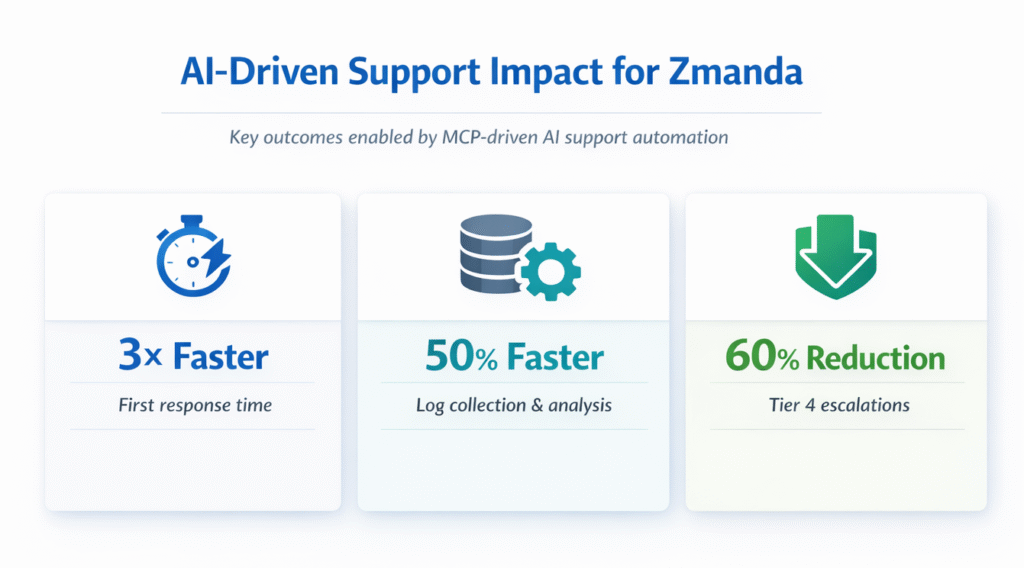
Business impact for Zmanda
By combining MCP with large language models, BETSOL delivered measurable operational improvements across Zmanda’s support workflows.
The challenge: fragmented support intelligence
Supporting Zmanda’s enterprise backup and recovery platform required engineers to navigate multiple internal systems to diagnose and resolve customer issues. Critical information existed in different locations, and manual investigation was often necessary to connect the dots.
Support workflows depended on gathering:
- customer environment details
- backup and restore job telemetry
- operational logs highlighting failures or anomalies
- historical support interactions
- relevant documentation and troubleshooting steps
Because this data lived across separate systems, engineers had to manually correlate signals during each investigation. As environments scaled, the process became increasingly time-consuming and cognitively demanding.
The core challenge was to enable intelligent reasoning across trusted, authorized contexts without exposing sensitive systems directly to AI models.
BETSOL’s approach: MCP-driven AI orchestration
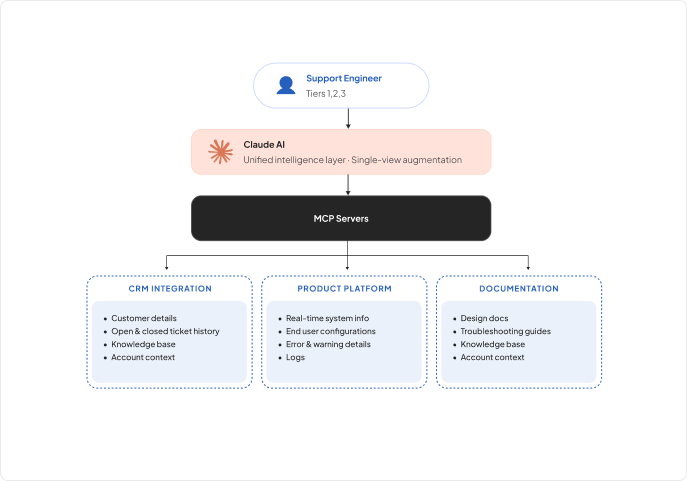
To address these challenges, BETSOL designed and built a dedicated MCP server for Zmanda. This server acts as a secure orchestration layer between Zmanda’s internal ecosystem and large language models.
Instead of allowing LLMs to directly query APIs or access sensitive data, the MCP server mediates every interaction. Its responsibilities include:
- gathering only authorized and relevant context from Zmanda systems
- structuring and sanitizing the data
- exposing the information to LLMs through well-defined tools
- returning actionable insights to support engineers
This architecture ensures that AI models focus on reasoning and synthesis, while Zmanda maintains full control over data access, governance, and security boundaries.
By separating intelligence from data access, BETSOL enabled a design that supports enterprise-grade AI adoption without introducing uncontrolled risk.
How the MCP server enables smarter LLM-based support
With the MCP layer in place, large language models can assist Zmanda support teams in a structured and secure manner. The MCP server provides the contextual grounding required for accurate AI reasoning.
Through this framework, LLMs can help support engineers by:
- correlating support tickets with the correct customer environment
- analyzing backup jobs, including failures, partial runs, and skipped operations
- identifying likely root causes based on operational signals
- retrieving the most relevant Zmanda documentation and troubleshooting steps
- generating high-confidence draft responses for support engineers
This approach allows support teams to move faster while maintaining accuracy and consistency. The LLM performs synthesis and pattern recognition, while the MCP server ensures that only appropriate, authorized data is used during the process.
Built for enterprise security and trust
Because Zmanda operates in enterprise environments, security was foundational to the MCP design. BETSOL implemented strict guardrails to ensure that AI-driven workflows do not introduce new risk surfaces.
Key security principles of the solution include:
- no direct LLM access to Zmanda APIs or credentials
- read-only access for operational data used in AI reasoning
- single sign-on authentication for support engineers
- authorization enforced at the MCP layer rather than the AI layer
- clear auditability of requests and responses
This model ensures that AI capabilities remain tightly governed within enterprise security requirements. Support engineers benefit from intelligent assistance, while Zmanda retains full visibility and control over how data is accessed and used.
Modular, agent-ready architecture
A key design decision in the MCP implementation was to expose purpose-built tools rather than relying on large, monolithic prompts. Each tool is designed to perform a focused task, such as:
- fetching customer context
- retrieving backup and restore job details
- accessing relevant tickets or documentation
This modular structure makes the system inherently extensible. Zmanda can evolve the platform over time by introducing specialized AI sub-agents for targeted tasks such as log analysis or knowledge extraction, without needing to redesign the core infrastructure.
The architecture is therefore not just optimized for current support workflows but also prepared for future AI-driven enhancements.
Why AI-native support infrastructure is the future
Many organizations experimenting with AI stop at chatbots or surface-level automation. While these tools can improve front-line interactions, they often fail to address the deeper operational complexity of enterprise support. For enterprise software providers, this architectural pattern represents a scalable way to embed intelligence into core workflows rather than layering AI on top as an afterthought.
True AI-powered support automation infrastructure is designed around three principles:
- Governed data access — AI models should never have unrestricted access to production systems. Authorization, scoping, and auditability need to be enforced at the infrastructure layer, not left to the model.
- Modularity — Monolithic AI implementations break under the weight of evolving product complexity. Purpose-built tools that perform focused tasks are easier to maintain, scale, and extend with new capabilities over time.
- Separation of reasoning and data management — LLMs are exceptional at synthesis and reasoning. They are poor system administrators. Infrastructure should handle data access and governance; models should handle intelligence.
Final thoughts
As enterprise platforms continue to grow in complexity, support organizations must evolve beyond manual investigation and fragmented tooling. Intelligent, context-aware automation is becoming essential to maintainyes responsiveness, accuracy, and scalability.
Through its work with Zmanda, BETSOL demonstrated how MCP and large language models can be combined to create a secure, AI-powered support automation framework. By mediating data access, enforcing governance, and enabling structured AI reasoning, the solution accelerates support workflows without compromising enterprise trust.