Recent AI partnerships between global technology leaders and frontier AI companies have sent a clear signal to the enterprise world: AI-first transformation is no longer a future consideration. It is a present-day competitive imperative.
Artificial intelligence is rapidly becoming the operating backbone of modern enterprises. Unlike previous technology waves such as cloud or mobile, the AI-first enterprise transformation shift introduces probabilistic systems that continuously learn, adapt, and influence decision-making across the organization.
For enterprises in contact center and healthcare environments, this shift is particularly consequential. Customer expectations are rising, operational complexity is increasing, and traditional automation approaches are reaching their limits. Organizations that treat AI as a bolt-on feature risk are falling behind those redesigning their operating models around intelligence from the ground up.
Why traditional enterprise architectures are breaking down
- The end of deterministic thinking
Enterprise software generally followed deterministic logic: defined inputs produced predictable outputs. AI systems fundamentally change this paradigm. Large language models and machine learning systems operate probabilistically, generating context-aware responses rather than fixed outcomes.
This shift requires new approaches to observability, governance, testing, and risk management. Legacy architectures were not designed for continuously learning systems, making legacy system modernization a critical first step in any AI-driven enterprise transformation. - The growing burden of legacy systems
Many enterprises still allocate the majority of their IT budgets to maintaining aging infrastructure. These environments create friction for AI adoption by limiting data accessibility, slowing release cycles, and increasing integration complexity.
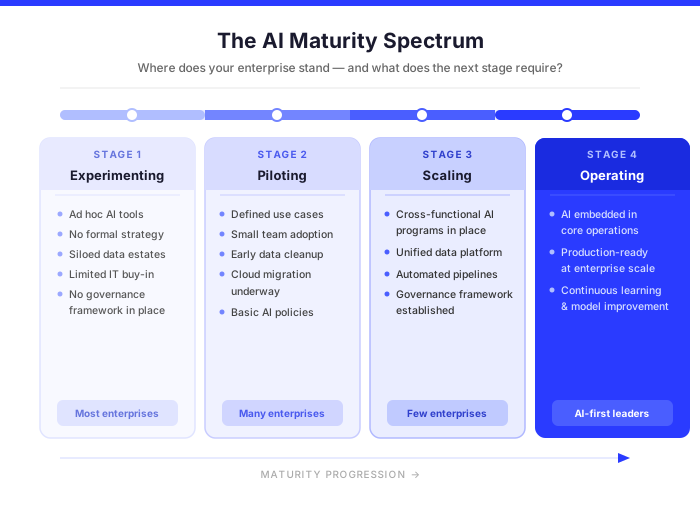
Without legacy system modernization, AI initiatives often stall at the pilot stage and fail to scale across the business. - Data readiness is the real bottleneck
AI success depends heavily on data quality, accessibility, and governance. Yet many organizations continue to struggle with siloed data estates, inconsistent pipelines, and limited real-time visibility. Before scaling AI, enterprises must establish strong data foundations that support reliable model performance and enterprise-wide trust.
Industry spotlight: Where AI transformation is accelerating
In industtries like healthcare and contact centers, the shift is not theoretical — it is already redefining how organizations operate, compete, and serve their customers.
AI in contact centers
Contact centers are among the fastest adopters of AI. Virtual agents, real-time agent assist, and conversational analytics are transforming both customer and agent experiences while driving significant efficiency gains.
The numbers reflect how quickly the shift is happening: 98% of contact centers worldwide were using some form of AI by 2025, with the majority seeing it as essential infrastructure for delivering 24/7 omnichannel support. The blended model, where AI handles tier-one queries and seamlessly escalates complex cases to human agents with full context, is becoming the new baseline for customer experience.
What separates high-performing contact center AI implementations from underperforming ones is rarely the technology itself. It is the quality of the underlying data, the sophistication of the workflow design, and the governance structures that ensure AI interactions remain accurate, compliant, and on brand.
AI in healthcare
Healthcare is one of the most data-rich and governance-sensitive environments for AI adoption, and it is moving fast. In 2025, an estimated 70% of healthcare organizations were actively pursuing or piloting generative AI, with applications spanning clinical decision support, administrative workflow automation, and patient engagement.
The potential is significant. AI can help clinicians surface relevant patient history in seconds, automate prior authorizations and claims processing, and flag anomalies in diagnostic imaging that might otherwise be missed. These are not marginal efficiency gains. They translate directly to better patient outcomes and reduced operational burden on already stretched healthcare systems.
But the governance requirements in healthcare are uniquely demanding. HIPAA compliance, patient data privacy, algorithmic transparency, and bias testing are not optional considerations, but baseline requirements. In this environment, the ability to build AI solutions that are both powerful and trustworthy is what separates viable implementations from ones that never leave the pilot phase.
Key imperatives for AI-first enterprises
Navigating AI-first enterprise transformation demands a coordinated shift across strategy, infrastructure, data, and governance. Here are the imperatives that separate organizations scaling AI from those stuck experimenting.
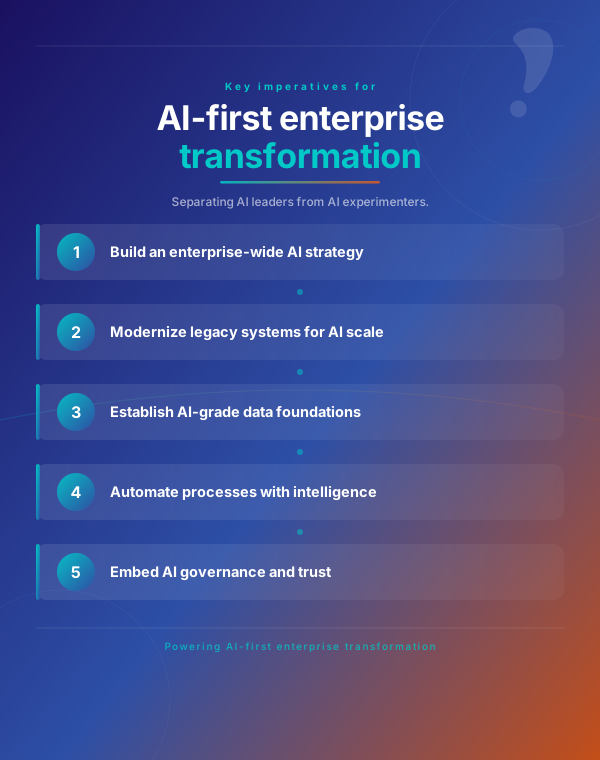
1. Build an enterprise-wide AI strategy
Moving from scattered pilots to a coordinated enterprise AI strategy requires defining clear objectives, aligning data and platform investments to business outcomes, and establishing a center of excellence that drives standards, reduces duplication, and accelerates reuse across the organization. Without this strategic foundation, AI initiatives tend to proliferate in pockets while delivering limited enterprise-wide value.
2. Modernize legacy systems for AI scale
Cloud-native architectures, microservices, and automated infrastructure provide the flexibility required for AI workloads. For compute-intensive models, pairing this foundation with an AI cloud platform that offers on-demand GPU resources can accelerate model training and inference at enterprise scale. Enterprises must prioritize modernization initiatives that reduce technical debt and enable faster experimentation.
3. Establish AI-grade data foundations
A unified data platform is the backbone of any AI-first operation. Enterprises need real-time data pipelines that can ingest, normalize, and govern data from across the business, with observability controls that surface quality issues before they reach AI models. This requires organizational commitment — clear data ownership, cross-functional governance, and a culture that treats data integrity as a strategic asset rather than an IT afterthought.
4. Automate processes with intelligence
The next generation of automation combines AI reasoning with workflow orchestration. Rather than simple task automation, enterprises are deploying intelligent systems that augment human decision-making and continuously improve outcomes. The goal is not to replace human judgment but to augment it. The most effective AI deployments are designed so that AI handles the high-volume, routine work — freeing human experts to focus on exceptions, edge cases, and decisions that require nuance. Across telecom, healthcare, and contact centers, this human-AI collaboration model is increasingly becoming the operational standard.
5. Embed AI governance and trust
As AI becomes more deeply embedded in enterprise operations, the stakes around governance rise significantly. Enterprises must implement guardrails, human-in-the-loop mechanisms, and robust monitoring to ensure responsible AI deployment.
How BETSOL is powering AI-first enterprise transformation
BETSOL’s approach to AI-driven enterprise transformation is grounded in one principle: production-ready over proof-of-concept. Rather than delivering isolated experiments, BETSOL partners with enterprises to build the cloud infrastructure, data foundations, and intelligent automation frameworks that allow AI to scale across the business.
The following implementations illustrate what that looks like in practice.
1. AI-powered virtual agent platform for a contact center provider
A leading contact center provider needed a scalable, well-governed environment to support virtual agent development across multiple regions. BETSOL deployed a Cognigy-based AI flow platform into the client’s Google Kubernetes Engine environment, building a customized front-end studio, automating multi-region infrastructure provisioning with Terraform, and establishing regional monitoring dashboards for operational visibility.
The result was a production-capable virtual agent platform with repeatable deployment pipelines, enterprise-grade security controls, and a trained client team capable of managing NLP flows independently. This engagement demonstrates how enterprises can operationalize conversational AI at scale, not just launch a chatbot, but build the infrastructure and governance to run it reliably over time.
2. Real-time AI insights platform for a leading BPO
A major business process outsourcing provider was operating with manual quality assurance processes that covered less than 5% of customer interactions. The organization needed to evaluate how AI-driven agent assistance and post-call analytics could improve performance at scale.
BETSOL structured a cloud-enabled proof-of-concept environment integrating Uniphore U-Assist and U-Analyze into the client’s contact center ecosystem. The engagement included AWS infrastructure configuration, multi-AZ networking, security and compliance readiness, and cross-team enablement. While the initiative informed future decisions rather than moving directly to full production, it established the technical validation and organizational alignment needed to pursue AI-assisted contact center capabilities responsibly.
3. AI-Enabled self-service analytics for a university
A university sought to expand access to institutional data beyond a small group of technically proficient users. Existing Power BI workflows required manual navigation and ongoing training, limiting the reach of data-driven decision-making across students, faculty, and leadership.
BETSOL implemented a natural language analytics layer on top of the existing Power BI environment, enabling users to query institutional data using conversational inputs without needing deep BI expertise. The initiative reduced reporting friction, expanded self-service analytics adoption, and demonstrated how organizations can extend the value of existing data investments through intelligent interfaces — without replacing what already works.
4. AI-powered support automation for an enterprise data protection platform—Zmanda
As Zmanda evolved, its support complexity grew alongside it. Engineers needed faster ways to correlate information across customer environments, backup logs, support tickets, and product documentation without manually navigating multiple systems under pressure.
BETSOL designed and built a Model Context Protocol (MCP) server that acts as a secure orchestration layer between Zmanda’s internal systems and large language models. Rather than giving AI models direct access to sensitive data or APIs, the MCP server gathers only authorized, relevant context, structures and sanitizes it, and exposes controlled tools to the LLM, which then returns actionable insights to support engineers.
The result is faster issue triage, more consistent support responses, and a scalable AI foundation that maintains strict control over security and data governance. This implementation is a strong example of building AI-native infrastructure that works within real enterprise constraints, not a demo environment, but a system that supports production support operations.
With over 150 engineering certifications, a global delivery model, and a consistently maintained 95%+ CSAT score, BETSOL brings the technical depth and operational discipline that enterprise AI transformation demands. Across telecom, healthcare, and contact centers, the goal is the same — not just to implement AI, but to build the infrastructure and governance that makes it last.
Discover BETSOL’s AI Services →
Preparing your enterprise for the AI-first future
Becoming an AI-first organization demands coordinated change across people, processes, data, and platforms. Leaders must invest in modernization, strengthen data foundations, and establish governance models that enable responsible scale.
Enterprises that move decisively today will be better positioned to unlock new efficiencies, enhance customer experiences, and build sustainable competitive advantage in the AI-driven economy.
Final thoughts
The transition to AI-first operations is already underway across industries. Organizations that rethink their architectures, data strategies, and operating models now will define the next generation of digital leaders. With the right foundation and execution partner, enterprises can move beyond experimentation and realize AI’s full transformative potential.